Overview
Conventional cryopreservation (“slow cooling”) forms crystalline ice, while vitrification (“ultra-fast cooling”) forms non-crystalline (amorphous) ice referred to as glass because it is transparent. Vitrification allows for quick and easy preservation and is suitable for work with minimal resources However, because of the lack of standardization, there are no adequate devices for vitrification with aquatic species, and previous work has been constrained by the need to use devices, such as microbiological inoculation loops, that were not designed for freezing. Specialized devices are intrinsic to cryobiology research, and must be capable of withstanding cryogenic temperatures. As such, vitirification devices are often expensive and designed for specific purposes, such as freezing of human embryos which reduce the utility for adaptation for applications such as vitrification of fish sperm or embryos. The few existing options also constrain starting points for development of new device, and vitrification devices often have to be crafted from available materials such as French straws. In response to this we have used PLA and ABS for prototyping vitrification devices by 3-D printing. The thermal properties allow devices to remain pliable and ductile at cryogenic temperatures and create broad-ranging opportunities for cryobiology research and application. We can custom design devices for vitrification that would not be feasible using other fabrication methods. We refer to this category as Vitrification Storage and Identification Device (VSID) (fig. 1). The technology of 3-D printing enables rapid design of multiple versions for testing, and these prototypes can be improved for broader testing and refinement to create self-contained devices that can be permanently labeled and will standardize vitrification of sperm. Commercially available vitrification loops and straws have been modeled to evaluate capability for maximal cooling.
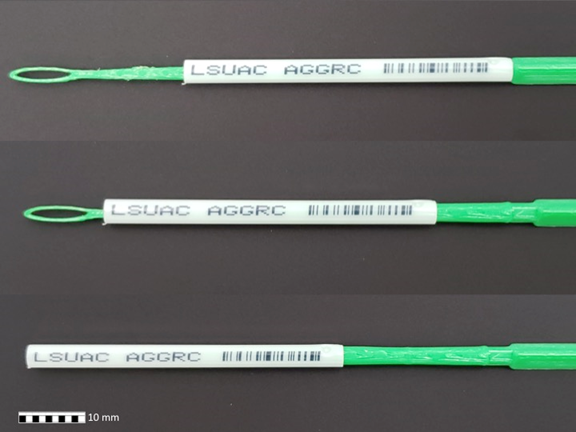
Fig. 1. The 3-D printed vitrification devices that can be properly labeled and stored for long-term sample preservation.