Overview
On-site cryopreservation of germplasm in nitrogen-vapor shipping dewars has been used for more than 35 yr to address these problems. Shipping dewars contain an adsorbent material that is designed to hold several liters of liquid nitrogen without the risk of spilling if the dewar is tipped over. These dewars typically have a narrow neck (diameter between 51 and 216 mm) and an overall height of between 470 and 671 mm. In usual practice, French straws or other containers are placed in an upper or lower plastic goblet attached to aluminum canes which are placed into a metal canister that is positioned within the shipping dewar for freezing. Differential placement of the goblet on the cane provides the ability to adjust the cooling rate. From 1990 to 2006, the World Fisheries Trust (WFT) focused exclusively on field cryopreservation, collecting sperm from wild stocks of salmonids (Oncorhynchus nerka, O. tshawytscha, O. kisutch, O. mykiss, and Salmo salar) and black cod (Anopoploma fimbria) in North America and the conservation of migratory fish species of the genera Salminus, Leporinus, Piaractus, Brycon, Pseudoplatystoma, and Prochilodus in South America. In 1995 and 1996, the WFT cryopreserved samples from 750 Sockeye Salmon that totaled 2,000 French straws representing 15 stocks by use of a field cryopreservation kit containing basically cryoprotectant solutions, straws, shipping dewars, and field notebooks. Despite the previous application of this method, there are still many limitations to on-site cryopreservation with shipping dewars. Due to the size of shipping dewars, these studies are small scale and can only produce tens of samples per day. The freezing temperatures that can be maintained and achieved are also affected by the size of the dewar, the number of samples being frozen (due to the cumulative heat load), and the amount of liquid nitrogen remaining in the dewar.
Over the past 15 years there have been successful adoptions of equipment and processes used in high-throughput
livestock cryopreservation for aquatic species. This equipment can include automated straw packagers and
computer-controlled freezers. Automated packagers are able to fill and seal 0.25-mL or 0.5-mL French
straws at a rate of as many as ~15,000 per hour depending on the model (e.g., MPP Quattro, www.minitube.com).
Programmable freezers are suited to handle the large output of straws from the automated packagers and
can automatically control the temperature inside the cooling chamber yielding uniform freezing. Other
equipment used during cryopreservation can include spectrophotometers to estimate sperm concentration
and flow cytometers to analyze membrane integrity. However, these instruments are delicate, expensive,
and not easily transportable.
Since beginning in 2000, the United States Department of Agriculture (USDA)-Agricultural Research
Service (ARS) National Animal Germplasm Program in Fort Collins, Colorado holds 99,683 aquatic species
samples in inventory, but those samples only represent 48 species of the estimated 33,000 finfish species,
with 6 of those 48 species being marine (Animal-GRIN, https://www.ars-grin.gov/). For a germplasm
repository to be effective, there must be proper representation of species and lines. Those samples
(tens to hundreds of thousands) also need to be of high quality. If on-site cryopreservation is going to
be an effective tool for multiple users, a customizable approach needs to be developed for the use of
high-throughput and specialized equipment in the field with the same quality control as a central facility.
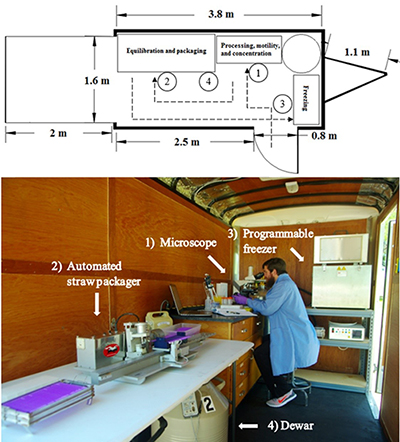
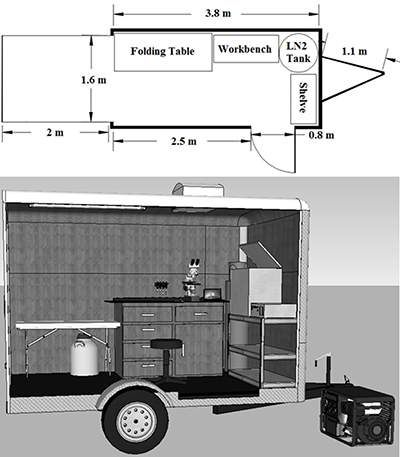
The goal of this project was to develop a self-contained mobile laboratory for on-site high-throughput cryopreservation of aquatic species. The objectives of this study were to: 1) identify how a mobile laboratory would function in different operational scenarios; 2) customize an enclosed cargo trailer to function as a mobile laboratory; 3) evaluate the laboratory layout and ability of cryopreservation equipment to operate from generator power, and 4) document the investment costs for private and public groups to integrate a mobile laboratory into an existing cryopreservation facility at three levels of automation, and estimate the total cost per trip based on hypothetical assumptions for two scenarios (aquaculture production and repository development). There were three operational designs identified for the mobile laboratory: 1) self-contained work inside the unit using generator power; 2) work inside the unit using external facility power, and 3) using the equipment inside of a host facility. The investment costs for a base-level mobile laboratory ranged between US$5,670 and US$5,787 for private groups and between US$5,208 and US$5,315 for public groups. With the addition of a range of automated processing equipment, total investment costs ranged from US$13,616 to US$103,529 for private groups and US$12,494 to US$94,891 for public groups. The total cost per trip to cryopreserve sperm of 59 Blue Catfish (Ictalurus furcatus) males to produce 6,300 0.5-mL French straws was estimated to range from US$6,089 to US$14,633 for private and between US$5,703 and US$16,938 for public groups depending on the level of automation. Total cost per trip to cryopreserve sperm of 500 males of 5 different species in the genus Xiphophorus to produce 641 0.25-mL French straws was estimated to range from US$6,653 to US$7,640 for private and US$7,582 to US$8,088 for public groups depending on level of automation. Overall, a commercial-scale mobile laboratory was developed that can assist current germplasm activities and support future repository and industry development, and the layout information provided can help others to design and build comparable units.