Overview
Motility analysis of zebrafish sperm is difficult due to the small sample yield for each fish, small cell size, and short motility duration (10–15 s peak initial motility). For externally fertilizing freshwater species such as zebrafish, motility is initiated by introducing the sperm to a hypo-osmotic environment. This drop in osmolality causes the initially dormant sperm to become active. Motility analysis is traditionally performed by first activating the sperm, typically by manual dilution of the sample with water and mixing by user’s hand, followed by visual estimation or use of computer-assisted sperm analysis (CASA) systems . The ~10 s time lag between activation and analysis, along with inconsistencies in activation due to human variation, are limitations in measuring peak motility of fish sperm, which can result in error-prone evaluation of sperm sample quality. Therefore, there is a need for a platform that enables the rapid mixing and activation of small volumes of zebrafish sperm cells and time sensitive motility analysis, which would allow for standardized methods to be developed across laboratories and repositories.
Microfluidic platforms have the ability to shorten analysis times and reduce the volumes of samples needed. Lab-on-a-chip (LOC) technology has been used in gamete-based studies to sort and orient sperm, and assess concentration and motility in a variety of species .
We have developed a microfluidic chip that facilitates research and quality control analysis of zebrafish sperm which, due to its miniscule (i.e., 2–5 μl) sample volume and short duration of motility (i.e., <1 min), present a challenge for traditional manual assessment methods. A micromixer molded in polydimethylsiloxane (PDMS) bonded to a glass substrate was used to activate sperm samples by mixing with water, initiated by the user depressing a transfer pipette connected to the chip. Sample flow in the microfluidic viewing chamber was able to be halted within 1 s, allowing for rapid analysis of the sample using established computer-assisted sperm analysis (CASA) methods. Zebrafish sperm cell activation was consistent with manual hand mixing and yielded higher values of motility at earlier time points, as well as more subtle time-dependent trends in motility, than those processed by hand. Sperm activation curves, which indicate sample quality by evaluating percentage and duration of motility at various solution osmolalities, were generated with on-chip microfabricated gold floor electrodes interrogated by impedance spectroscopy. The magnitude of admittance was linearly proportional to osmolality and was not affected by the presence of sperm cells in the vicinity of the electrodes. This device represents a pivotal step in streamlining methods for consistent, rapid assessment of sperm quality for aquatic species. The capability to rapidly activate sperm and consistently measure motility with CASA using the microfluidic device described herein will help improve the reproducibility of studies on sperm and assist development of germplasm repositories.
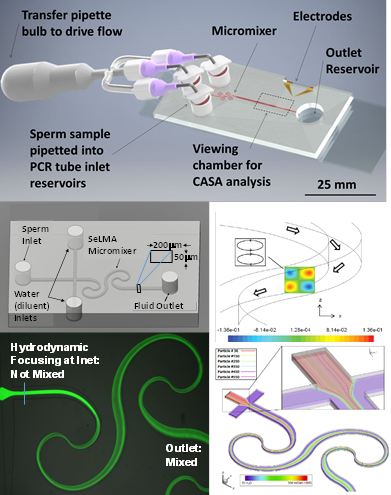
Fig.1. Microfabricated Activation & Motility Chamber (MAMC), a device permitting the rapid activation of sperm through on-chip mixing and positioning in a viewing chamber to be analyzed via CASA on an inverted microscope (rendering of unpublished prototype design). (A) Sequential Logarithmic Mixing Apparatus (SeLMA) design structure for mixing of cells and water in a single layered PDMS microdevice. (B) Fluorescent microscopy of A, verifying mixing of fluorescein and water. (C and D) Computational fluid dynamics simulations optimizing geometry for Z-velocity profiles to achieve Dean vortices for mixing and osmotic environment cells experience through the mixer.