Background
Livebearing fishes employ unique reproductive features, including internal fertilization,
packing of sperm, and intraovarian development of embryo. They have great value for research,
aquarium, and environmental control. Poeciliidae is the largest freshwater livebearing family,
comprising more than 200 livebearing species. Among them, about 31 are threatened (critically endangered,
endangered, and vulnerable) according to the Red List of International Union for Conservation of Nature (IUCN).
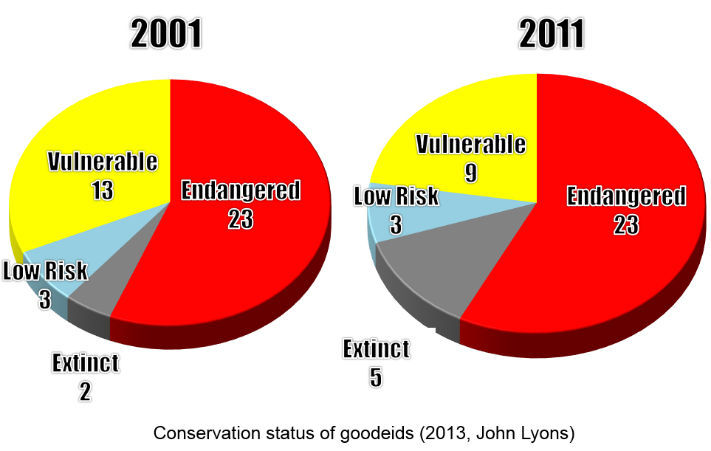
The second largest family Goodeidae has around 40 species and more than half of them are threatened according to
Goodeid Working Group (GWG, http://www.goodeidworkinggroup.com ).
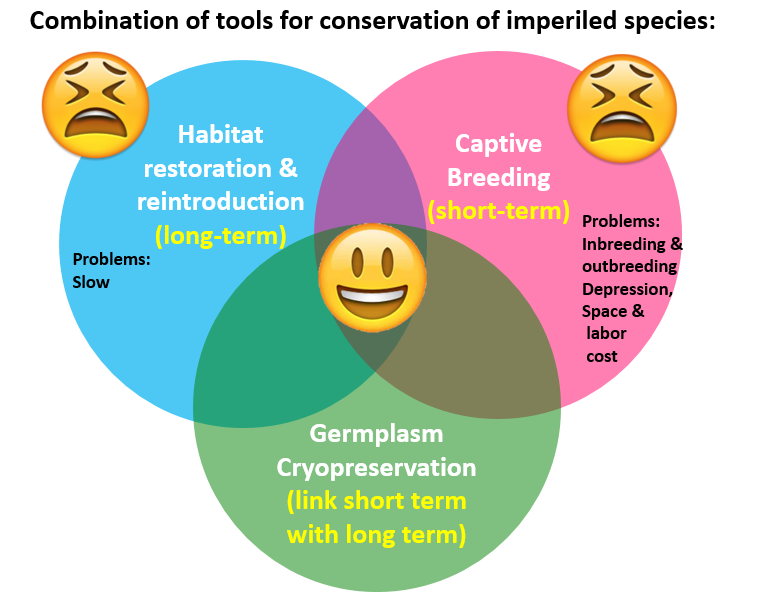
Recovery programs for endangered or threatened species require a combination of various conservation tools such as status assessment,
legislation, habitat restoration and management, translocation, and captive breeding. However, limitations of certain tools challenge
implementation of such programs. For example, long-term efforts such as habitat restoration can take decades, but population sizes and
genetic diversity of concerned species can continue to decline in nature before full restoration. Shorter-term efforts such as captive
breeding are at risk due to disease outbreaks, administrative discontinuity, high costs, and inbreeding depression. Repositories of
cryopreserved germplasm can become a necessary addition to the conservation toolbox to address these challenges by preserving germplasm
for future use at a relatively low cost, ensuring integrity of genetic diversity, enabling genetic assessment, and enhancing captive breeding.
This tool has been used to improve diversity in recovery of endangered mammals such as black-footed ferret. However, it has been neglected
in conservation programs of imperiled fishes. For example, in 86 current recovery plans of endangered or threatened fishes developed by U.S.
Fish & Wildlife Service, only 2 have mention of cryopreservation, and that was for research purposes.
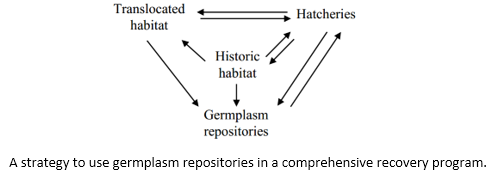
We have developed a recovery plan using Redtail Splitfin (Xenotoca eiseni) as a model to demonstrate a comprehensive
strategy to couple germplasm (sperm) repositories with conventional conservation tools. Sperm from X. eiseni from wild
populations can be cryopreserved on-site in French straws, and the straws shipped to a central repository. When wild
populations are brought to hatcheries, sperm from these stocks can be cryopreserved from successive generations and be used
when necessary to maintain desired levels of genetic diversity and reduce inbreeding of broodstocks. When historic or
translocation habitats are ready, germplasm can be incorporated into live populations in hatcheries for introduction to
the habitats. Successful recovery requires a practical conservation plan as well as strong collaborations among people and
agencies with specialized expertise and function. A calculator model was developed to assist linkage of expertise with germplasm
repositories. Based on desired retention of heterozygosity, inbreeding, and effective population size, the brood sizes from cryopreserved
germplasm to be incorporated into captive stocks can be calculated.