Overview
The community of coral researchers puts great effort into conservation and restoration in the face of warming,
acidifying oceans. One element of this effort is research into the cryopreservation of coral sperm, larvae,
and adult fragments.
With rising ocean surface temperatures, coral researchers have seen a corresponding increase in major
bleaching events. These events, in which corals expel their symbiotic algae, weaken the corals and often
cause mass mortality over enormous areas. This alarming trend on the Great Barrier Reef in particular has
been much in the news, but it is a global problem.
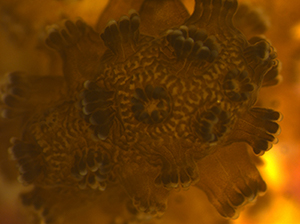
Corals are the foundation of a complex ocean ecosystem comprising thousands of species of invertebrates and
fish, many of which are of economic and nutritional value to humans. Some half-billion humans ultimately
depend on corals for their livelihood or food; reefs sustain many billions of dollars’ worth of tourism and
fishing and provide physical protection to otherwise vulnerable shorelines.
Many research and conservation groups are working on ways to sustain coral genetic diversity and to
reduce the damage caused by human activity. These approaches are complementary: for example, a frozen and
revived coral specimen must then be sustained and grown out. Research into reliable regrowth therefore goes
hand-in-hand with cryopreservation.
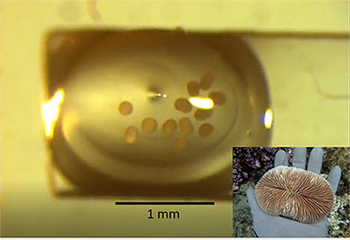
Cryopreserved larvae of the mushroom coral, Lobactis scutaria, in a droplet of glassy cryoprotectant at −196 °C. Inset: an adult mushroom coral.
Coral sperm has been successfully cryopreserved many times in the past decade. About 30 species are
now represented in frozen banks maintained by the U.S. Department of Agriculture, the Smithsonian Conservation
Biology Institute, and Australia’s Taronga Zoo. Recent experiments have shown that years-old coral sperm
remains viable, and can be used to assist the flow of genes between geographically separated populations of
a species (Hagedorn et al., in pre-print). This is likely to be helpful: more genetic variety in a population
tends to increase resilience and species survival in the face of stress and environmental change.
Frozen sperm are, of course, only half of the answer, since they need live eggs to fertilize. Unfortunately,
eggs are fiendishly difficult to cryopreserve. In the case of coral, a fertilized egg quickly develops into
a free-swimming larva that will ultimately settle on a rocky surface and grow into a new coral colony.
If this larva can be cryopreserved, then we will have an effective hedge against extinction in the wild: at
any time in the future, larvae may be thawed, settled, and allowed to grow into reproductive adults.
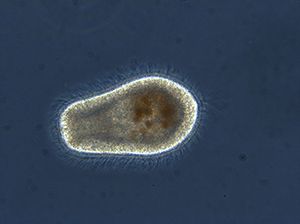
A successfully laser-warmed larva of the mushroom coral. Its symbiotic algae are visible as small golden spheres inside the larva.
Recent work in the lab of Dr. Mary Hagedorn of the Smithsonian Conservation Biology Institute has led to the development of a protocol for the cryopreservation of coral larvae. Briefly stated, the larvae are vitrified (rapidly frozen into a glassy state), stored in liquid nitrogen, and warmed in a fraction of a second with a welding laser (Daly et al. 2018). This yields live larvae that are capable of settling and metamorphosing into the adult form.
The AGGRC Contribution
The cryopreservation of coral sperm and larvae is at present a relatively small-scale effort. It depends
on small groups of scientists conducting field work a few times each year. Part of this cannot be
helped: coral only spawns at certain times of year, and each species has its own spawning rhythm.
However, the coral community is in need of standardized devices and procedures that will increase the
ease and reliability of banking. This is where AGGRC comes in.
The Aquatic Germplasm & Genetic Resources Center, in collaboration with the Smithsonian
Conservation Biology Institute, has established a graduate student position at Louisiana State University
for the continued development of devices and techniques for coral cryopreservation. The main objective
is the refinement of a device (currently under provisional patent: see Hagedorn 2019 in references) for
rapid serial vitrification of coral larvae. This is an early step toward the larger goal of banking
coral larvae in large numbers.
References
Hagedorn, M., Zuchowicz, N., Daly, J., Bischof, J., Zhan, L. and Khosla, K. 2019. High throughput system for production and vitrification of biomaterials in cryoprotectant droplets. United States Patent and Trademark Office, application serial no. 62/811,847.