Overview
The thermal properties of PLA make it suitable for cryogenic applications, such as the fact that 3-D printed PLA has minimal deformation when cooled and it can be safely handled immediately after removal from LN2. Because most 3D-printed parts have relatively low density (due to the honeycomb infill that produces porosity) they cannot effectively withdraw and store heat, thus reducing risk of freeze injuries to personnel. Also, because most plastics typically have much larger thermal expansion coefficients than metals, they shrink when chilled and present challenges in cryogenic designs. In contrast, the thermomechanical behavior of printed PLA objects shows little geometric distortion when cryogenically cooled. Because PLA has a lower glass transition (Tg) temperature than ABS and many other plastics, it can be extruded at cooler temperatures, and when deposited, cools in uniform fashion, thus preventing buildup of internal stresses that could cause distortion when exposed to cryogenic conditions. These traits enable printing of complicated devices with multiple, small, interlocking parts that can maintain structural integrity to ensure coordinated movement of samples across a broad temperature range. We refer to this category of apparatus as a Controlled Cooling Conveyer Device (CCCD) (Fig. 1).
Current equipment for controlled freezing are typically large, expensive instruments that consist of a cooling chamber for freezing of large batches of samples. Because of small sperm volume, typical batch freezing with a controlled apparatus is inefficient for individual zebrafish. We have been testing an inexpensive 3-D printed conveyer device that produces continuous, reproducible transit of individual samples above LN2. Individual samples can be placed in the CCCD as they are sealed and equilibrated. Preliminary measurements from thermocouples indicate that reproducible cooling rates can be achieved in the range of 4-40°C/min by adjusting the height and speed of the conveyor over LN2, and the stepper motor speed can be varied to adjust plunge temperatures. More advanced versions will be evaluated for accuracy and precision compared to a controlled-rate freezer.
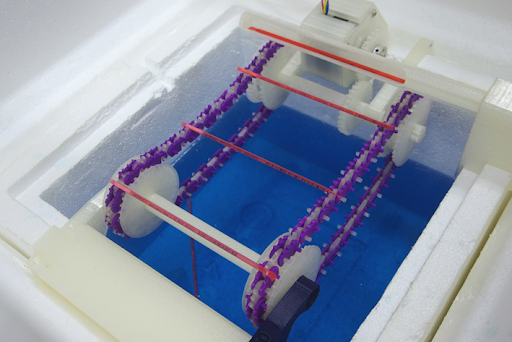
Fig. 1. A Controlled Cooling Conveyer Device (CCCD) intended to provide standardization and reproducibility of cooling rates for freezing of individual samples. The components are 3-D printed. Samples can be introduced into the equilibrated freezing chamber from the side onto the twin chain drive. Prototype testing has ensured that all components including the stepper motor can function at standard cryogenic working temperatures. All of the parts are inexpensive and easily accessible.